Say what a player is good at, and what to do about it
A skill matrix your club writes itself, exercises whose metrics feed several skills at once, and feedback built around specific improvement points with a drill attached to each one. Free forever, on the web and in the app.
Start evaluating players“She’s a decent setter” is not an assessment
Two coaches watching the same trial will rank the same twenty players differently, and neither can say why in a way the other can check. At selection time that becomes an argument nobody can win, and the player who was cut never finds out what they were missing.
The fix is not more numbers. It is agreeing what the numbers mean before anyone scores anything, and then telling the player something they can act on.
Your club decides what each level means
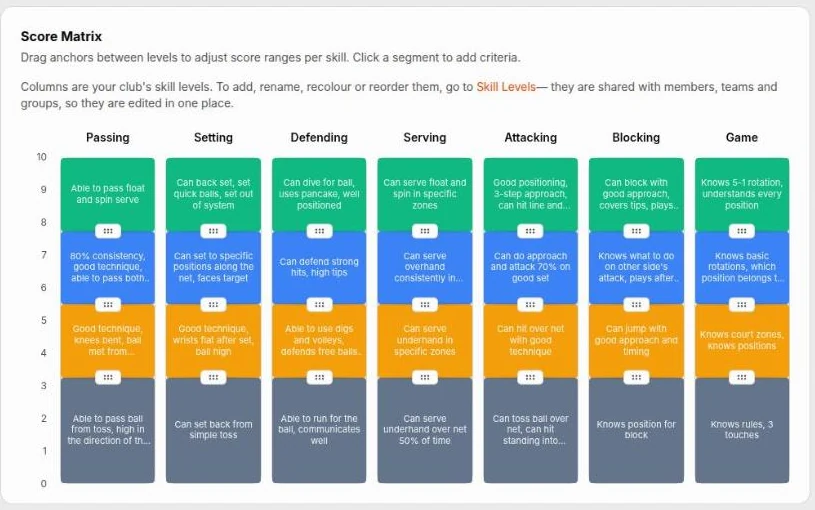
Seven skills — passing, setting, defending, serving, attacking, blocking and overall game — split into your club’s own levels, with a score range behind each band and the criteria written into it in your words. “80% consistency, good technique, able to pass both” is a standard two coaches can apply the same way. Drag the anchors and the ranges move with them.
One drill, scored once, feeding several skills
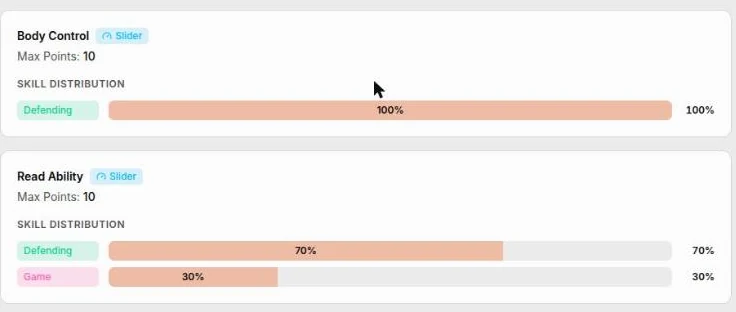
An exercise is made of metrics, and each metric carries a weighting across the skills it genuinely tests. In this defensive drill, successful digs and body control count entirely towards defending — but read ability is 70% defending and 30% game sense, because that is what it is. Score the drill once and both skills move.
- Checkbox — Did they do it or not — for the things that are simply yes or no
- Slider — One to ten, for technique and anything else a coach judges by eye
- Number — A count against a target — nine of a target ten
- Ratio — Eight out of ten serves in, recorded as what it is
Exercises you do not have to invent
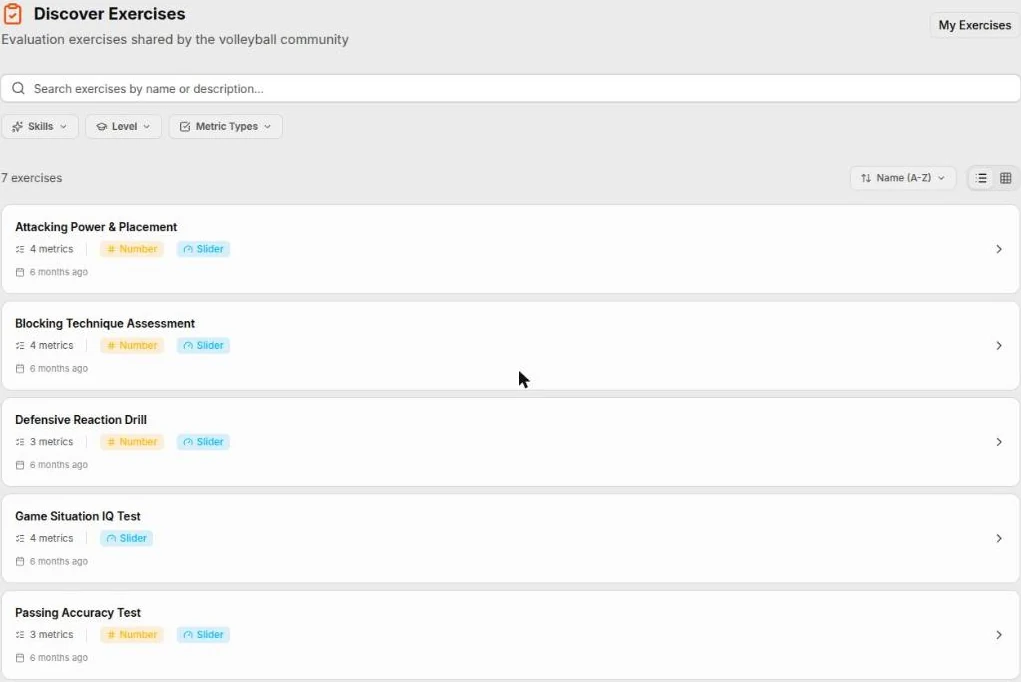
Write your own, or take one another coach has published and adapt it. Each carries its metric count and the kinds of metric it uses, so you can tell at a glance whether it is a stopwatch exercise or a judgement one.
Then tell the player something they can use
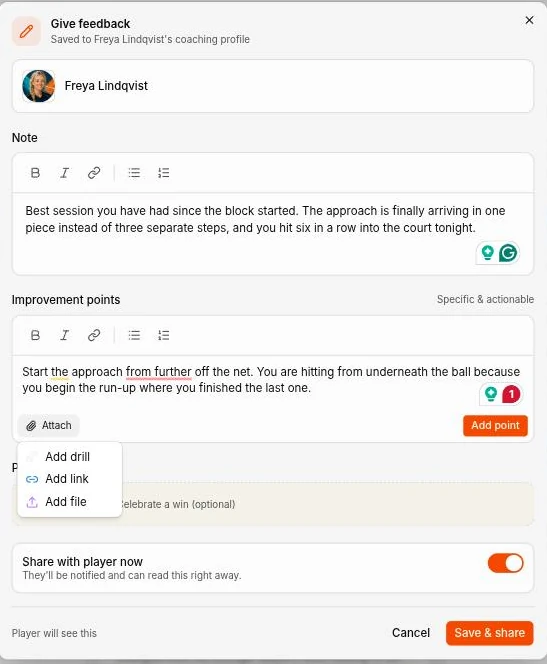
A score out of ten is not coaching. Feedback in Spike is a note in your own words, and under it as many improvement points as the player needs — each one specific and actionable rather than a paragraph they have to decode.
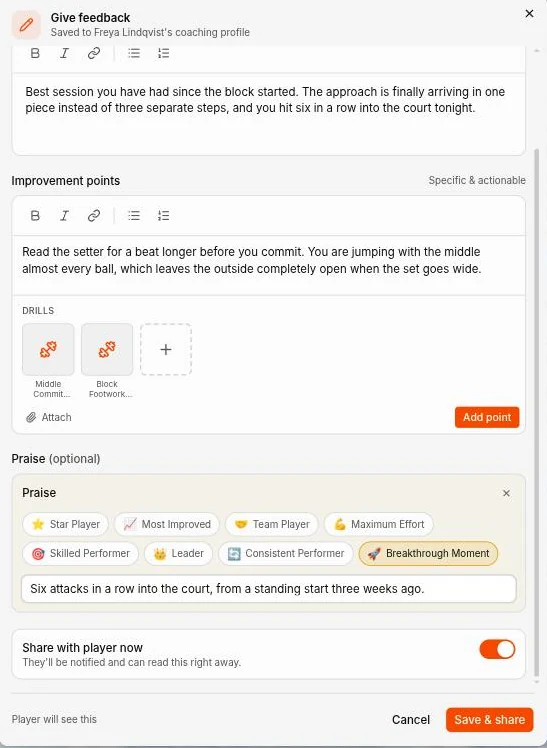
Every point can carry drills straight from your library, so “read the setter for a beat longer” arrives with two blocking drills attached and the player has something to do on Tuesday. Add a praise with a badge on it, and choose whether to share now or keep drafting.
A drill, a link, or a file — on the point itself
Attachments hang off each improvement point rather than off the feedback as a whole, so the video of the footwork sits with the point about footwork. Pull a drill out of your library, paste a link, or upload a clip you filmed on the night.
Everything you have said, in one place
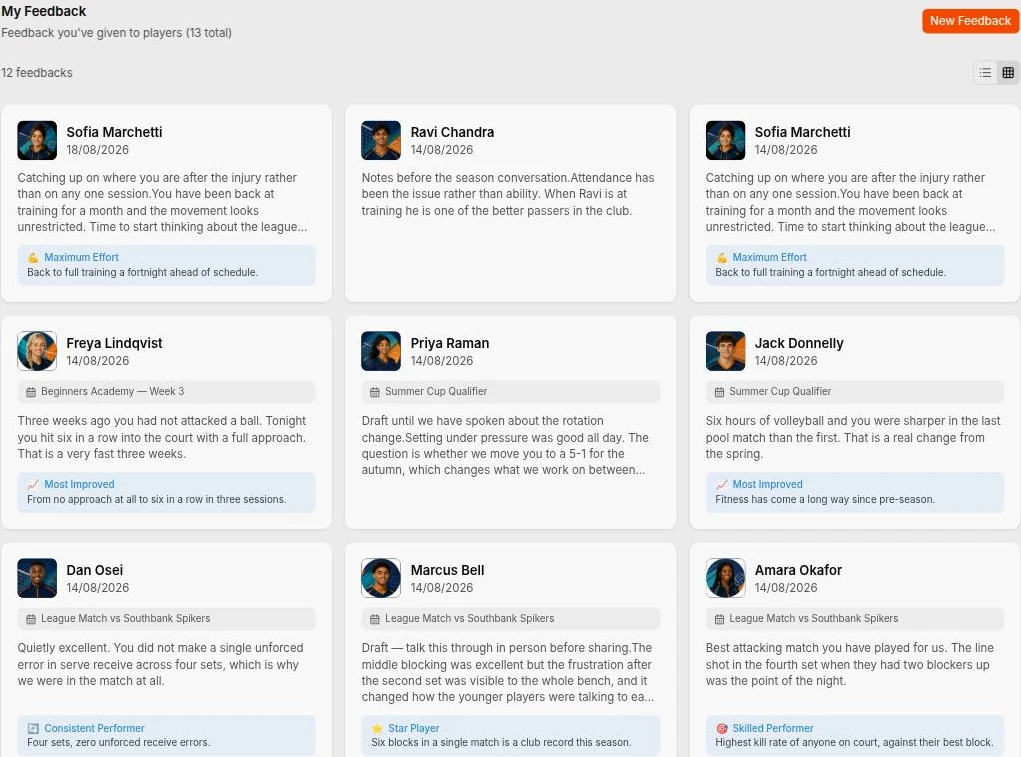
Feedback stays attached to the session it came out of, so a season reads as a sequence rather than a pile of one-off comments. Drafts sit alongside shared ones. Once you share, the player is notified, you can see whether they have opened it and when they last did, and if you edit it afterwards they are told it changed.
Selection that survives the conversation afterwards
Set a minimum score for the club — overall, or for one skill — and every evaluation comes out as a pass or a fail against it. The bar was written down before the trial, it is the same bar for everyone, and a player who did not make it can be shown exactly which skill fell short and what to work on before the next one.
Who it’s for
Clubs running trials
The threshold is written down before the session, so selection comes out of the scores rather than out of an argument afterwards.
Coaches with a big squad
Twenty players and one of you. Feedback per player, with a drill attached to each point, is the only version of this that survives contact with a Tuesday night.
Players who want to know where they stand
Not a score out of ten with no explanation — the specific thing to work on, and something to go and do about it.
Common questions
What is a skill matrix?
Your club's own definition of what each level of a skill looks like. Seven skills — passing, setting, defending, serving, attacking, blocking and overall game — each split into your club's levels, with a score range behind every band and criteria written into it in your words. It is what turns "she's a decent setter" into something two different coaches grade the same way.
How does scoring a drill turn into a skill score?
An exercise is made of metrics, and each metric is weighted across the skills it actually tests. A defensive drill's read-ability metric might count 70% towards defending and 30% towards game sense. Score the drill once and both skills move, weighted — so one exercise feeds the whole picture instead of you grading seven skills separately.
How do you record a score?
Four kinds of metric, so you use whichever suits the drill: a yes/no checkbox, a 1–10 slider, a number against a target, or a ratio like 8 out of 10 serves in. Nothing has to be forced into a five-star rating it does not fit.
Can I use this for trials and team selection?
Yes, and it is the most common reason clubs run one. Set a minimum score for the club — overall, or for one skill — and each player's evaluation comes out as a pass or a fail against it. The threshold is written down before the trial rather than argued about after it.
What is in a piece of feedback?
A note written in rich text, and under it as many improvement points as the player needs — each one a specific, actionable thing to work on rather than a paragraph they have to decode. A point can carry drills from your library, links, and files. Optionally a praise with a badge on it. You choose whether to share it now or keep drafting.
Can I attach a drill to feedback?
Yes, and that is the point of the improvement point. "Read the setter for a beat longer" is advice; the same point with two blocking drills attached is something the player can actually go and do on Tuesday. You can attach drills from the library, a link, or a file — to each point separately, not just to the feedback as a whole.
Do players see their scores?
Only what you choose to share. Feedback is written per player and shared deliberately, so you can draft honestly and decide later what the player sees. Once shared, they are notified and you can tell whether they have opened it — and when they last did. Edit it afterwards and they are told it changed.
Is it just numbers?
No — the numbers are the least useful half. Alongside them a coach can award a badge with a message: star player, most improved, team player, maximum effort, skilled performer, leader, consistent performer, breakthrough moment. Badges are awarded by a coach, not unlocked by the player, and for most players that lands harder than a score does.
The rest of the club, too
Write down what good looks like
Set your club’s levels once, score against them, and give every player something specific to go and work on.
Start evaluating players