Volleyball scoring and player statistics, kept to the FIVB rules
A scorer’s console on the web that keeps the scoresheet to the FIVB 2025–2028 rules — toss, line-ups, time-outs, substitutions, liberos, sanctions and faults — and a stats console behind it that grades every touch. Match reports, player cards and season totals follow from what was recorded. Free, like the rest of Spike.
Score your next match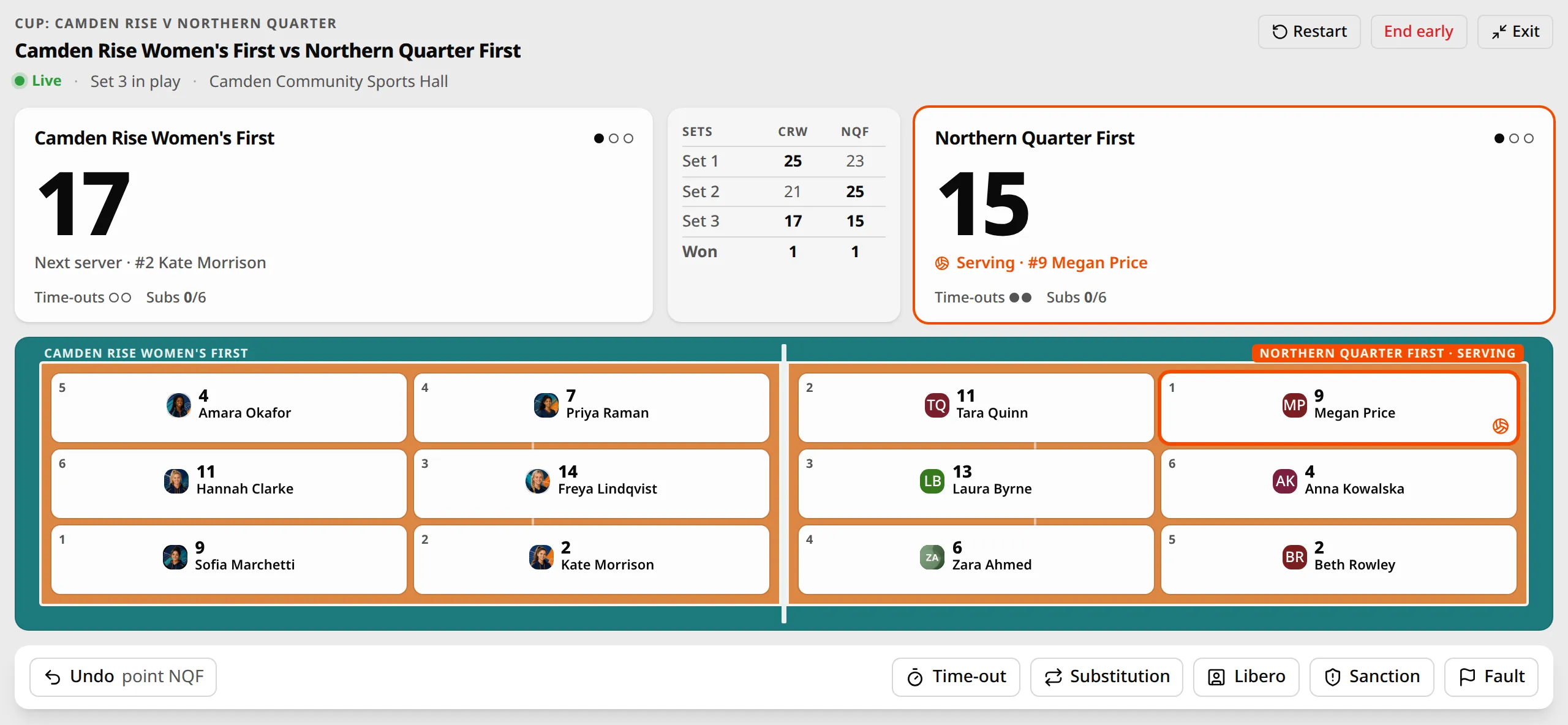
The scoresheet that ends up as a photo
Most club matches are scored on paper by whoever was free. The substitution and libero rules live in the scorer’s head, the running score on a flip chart, and the result reaches the club as a photo of the sheet in the group chat. A season later nobody can say how the second team did, let alone who was passing well.
Spike puts the scorer’s table on a laptop or a tablet. The console knows the rules, so the scorer records what happened rather than working out whether it was allowed, and the result is stored on the match the club already has in its calendar.
The scorer’s console
One screen from the toss to the result, written to the FIVB Official Volleyball Rules 2025–2028. On the small laptop most tables have, full screen keeps the court above the fold.
The zones as the console draws them: 4, 3 and 2 along the net, 5, 6 and 1 behind. At the first serve position I stands in zone 1 and serves. A side that wins the serve back rotates one place clockwise, and the court on screen turns with it.
- The toss — Who serves first and which side is on your left. A deciding set gets its own toss and changes ends at 8.
- Line-ups — A sheet for each set, positions I to VI in serving order and up to two liberos, filled in at the table and locked. A team with no squad on Spike is still scored, without the court.
- Points and rotation — Tap the side that won the rally. The court turns, the server is marked, and the log names who served.
- Time-outs — Counted per team per set against the match's rules, with a 30-second clock.
- Substitutions — Six a set with the return rule: a starter comes back once, to their own place, for the player who replaced them. Exceptional substitutions for injury or a sending-off sit outside the six.
- The libero — Up to two designated per match. A replacement is checked for a completed rally since the last one, the front row and the serve, and the console warns when the libero has rotated somewhere they may not stand.
- Sanctions — Warning, penalty, expulsion, disqualification and the two delay sanctions, each doing what the rulebook says: a penalty is a point and the service, an expulsion must be answered with a substitution now.
- Faults — A rotation fault cancels the points scored out of order and puts the order back. A positional fault is a point and the service to the server, and since the 2025 rules only the receiving side can commit one.
- Undo — Every action is one line in the match log, so undo drops the last one whatever it was, and the log reads back the way the scoresheet's remarks would.
The rest of the table’s procedure is there too: recovery time, improper requests, the interval clock, and ending a match early as a forfeit, abandoned or by the organiser’s decision. Finishing stores the result, recalculates any standings the match belongs to and tells both squads.
Rules the match is actually played by
Not every club match is best of five. Before the toss the console asks how this one is played and offers the shapes clubs use. The rules lock at the first point or stat, a timed or fixed-set match can end level and is recorded as a draw, and scoring and stats read the same rules, so a set that ends 25–23 on the scoreboard ends there in the stats too.
- FIVB best of 5 — Sets to 25, fifth set to 15
- Best of 3 — Two sets to 25, third to 15
- 3 fixed sets to 25 — Every set is played, even after 2–0
- Timed sets — 20 minutes a set, whatever the score
- Open sets — Sets to 25, as many as you play
- Custom — Any sets, points, deciding set, cap, head start or time limit
Officials and statisticians on the event
A match event has an Officials step: referee, second referee, scorer and two line judges. Each is a member found by name, or just a name typed in for someone who is not on Spike, and the form flags one person given two roles. Whoever runs the event scores it — the organiser, or club and team staff with event permissions — and anyone else on the event sees the same console without the controls.
Stats are a side’s own. The people who run a team choose its statisticians, who keep that side’s stats on this match without running the team, and each side’s log is separate: a club keeps stats on its own players in a match the other club is scoring, and an organiser who runs neither team reads the reports without seeing either log.
Every touch, graded
The Stats tab records one side’s match touch by touch. Six skills — serve, reception, set, attack, block and dig — each graded on the scale statisticians already use: # for a point or a perfect touch, + good, ! OK, - poor, / blocked or an overpass, = an error. A serve carries its type, a pass the serve it received or a free ball, an attack a tip or a free ball given, and any touch the zone it started from and landed in.
There are two ways in. Type codes on a laptop — 5R# is a perfect pass by number 5, and the line under the code says what it means before you press Enter — or tap the court on a tablet: the player, the skill, the grade. Either way the console keeps the score and the rotation from what you enter and knows which grades end a rally. Keep stats live from the bench or from a recording afterwards, and enter a rally as just its ending when the point is all you need.
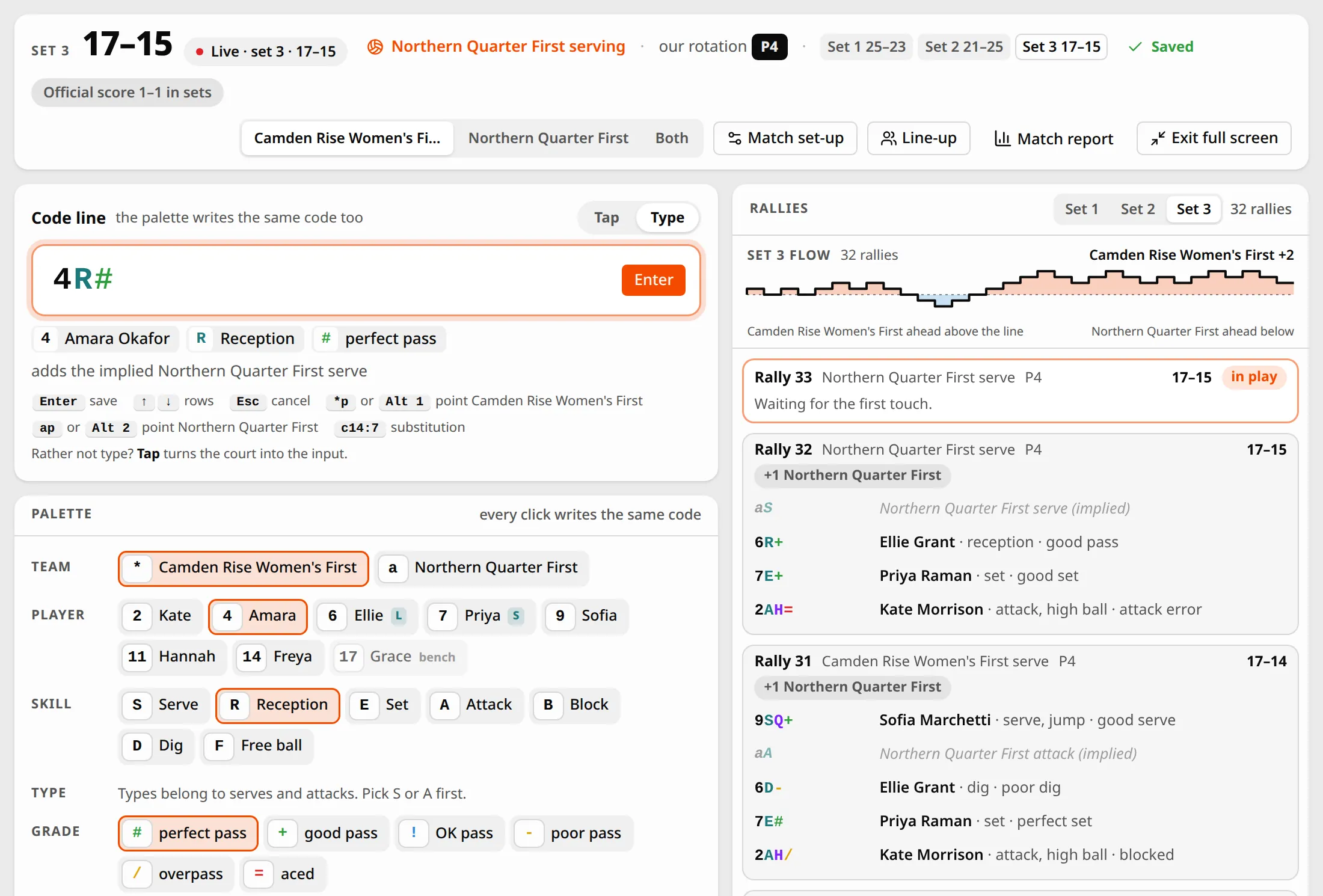
Mistakes are corrected in place: click any row to change it and the rallies after it are recalculated. The console also holds each set against the official score and, when the two disagree, says which set and by how much, so you can find the rally that went the wrong way. When nobody has scored the match, an organiser who kept the stats can use them as the result.
What comes out of it
Match report
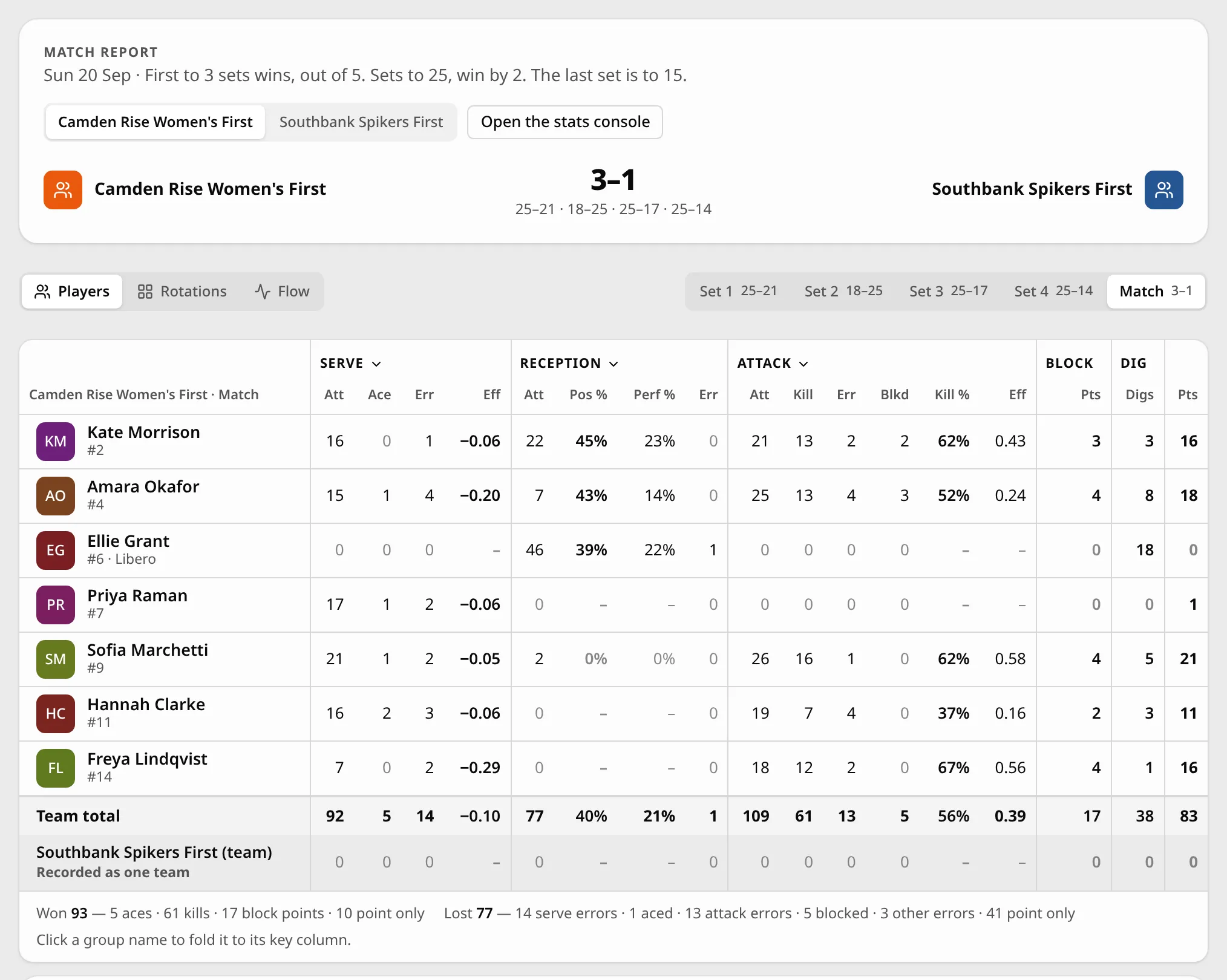
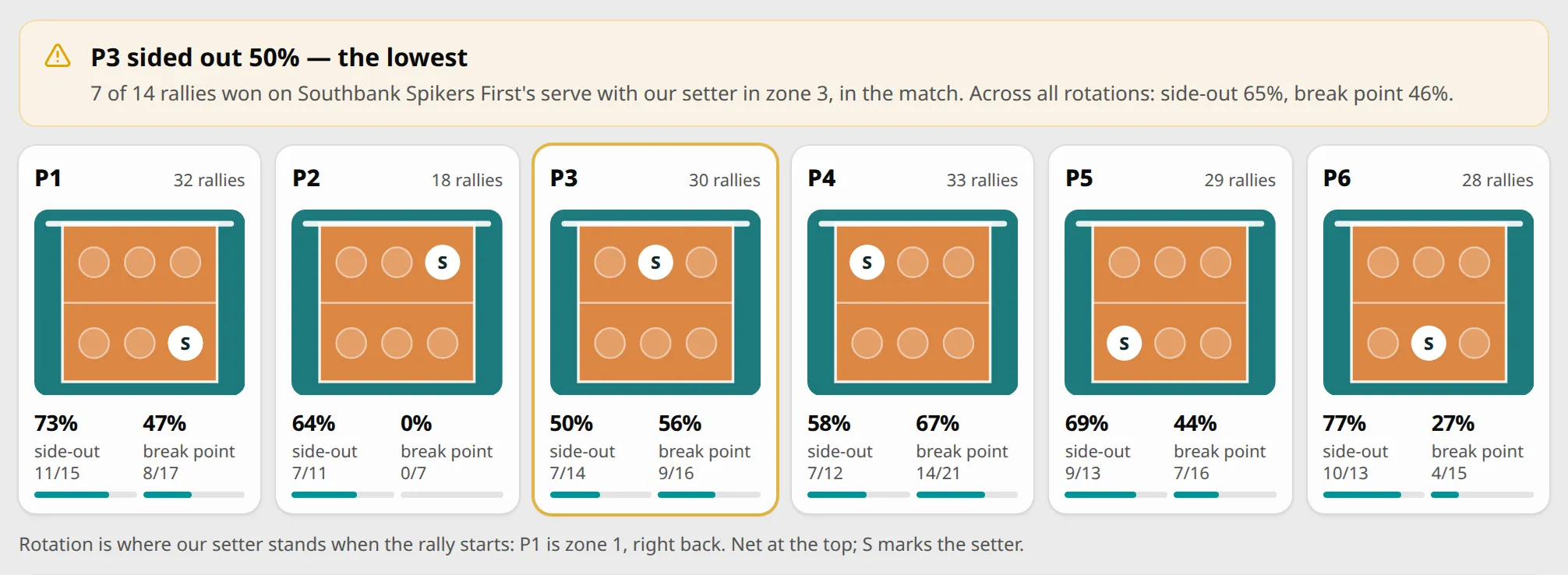
Every player's kills, kill %, attack efficiency, positive and perfect pass %, serve efficiency, digs, block points and points won, for the match or one set. Then the rotations, with side-out and break-point rates for each of the six and the weakest called out, and the flow: point by point through each set, with runs of three or more marked and how the points were won and lost.
Player card
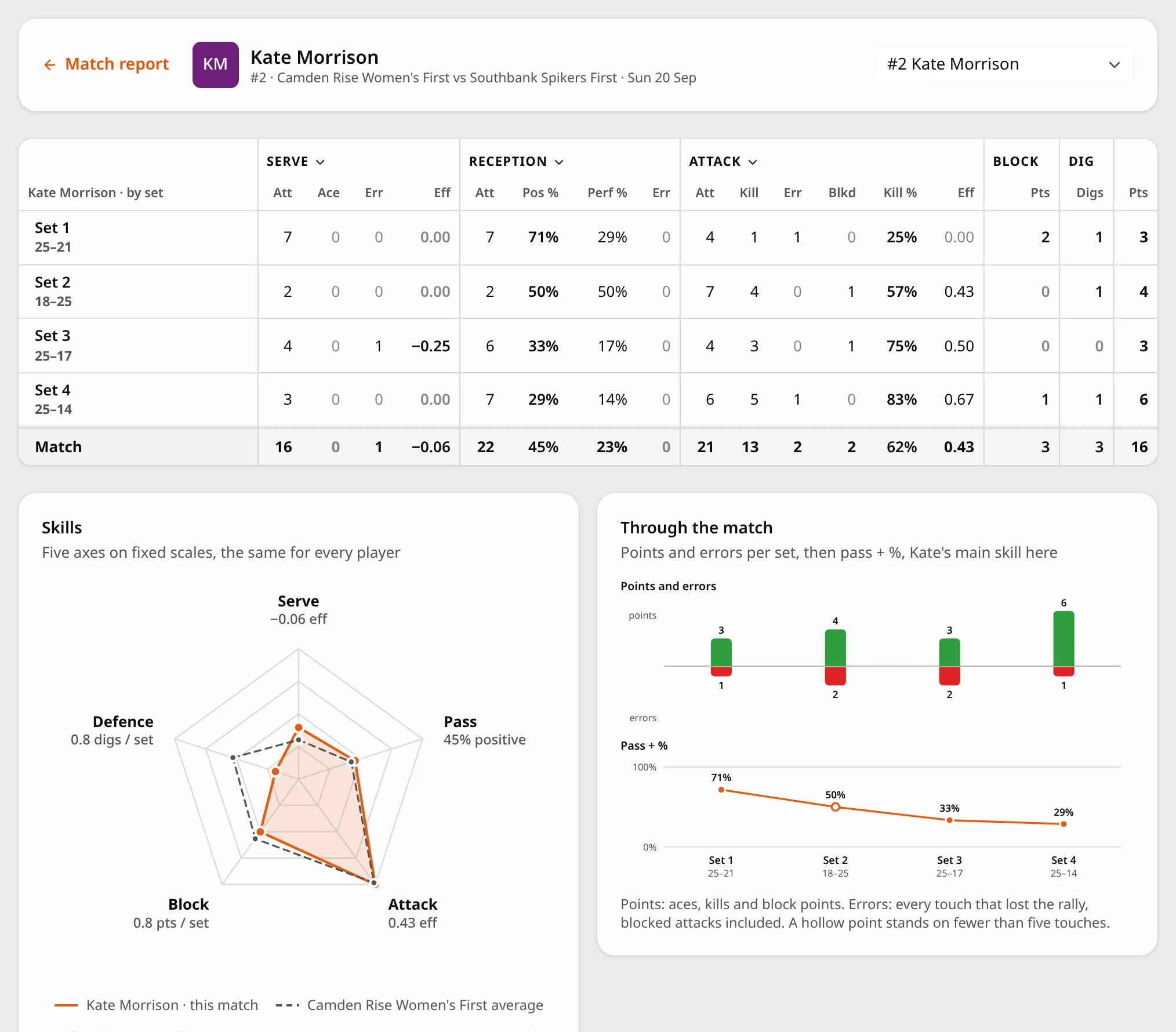
One player's match by set, a radar of five skills laid over the team's average, and points and errors through the match.
Team stats
Every match with stats in a date range, totals by player, rotations over the period, one figure through the season — side-out %, break-point %, kill %, pass + % or serve efficiency — and a few players' radars laid over each other.
Season totals
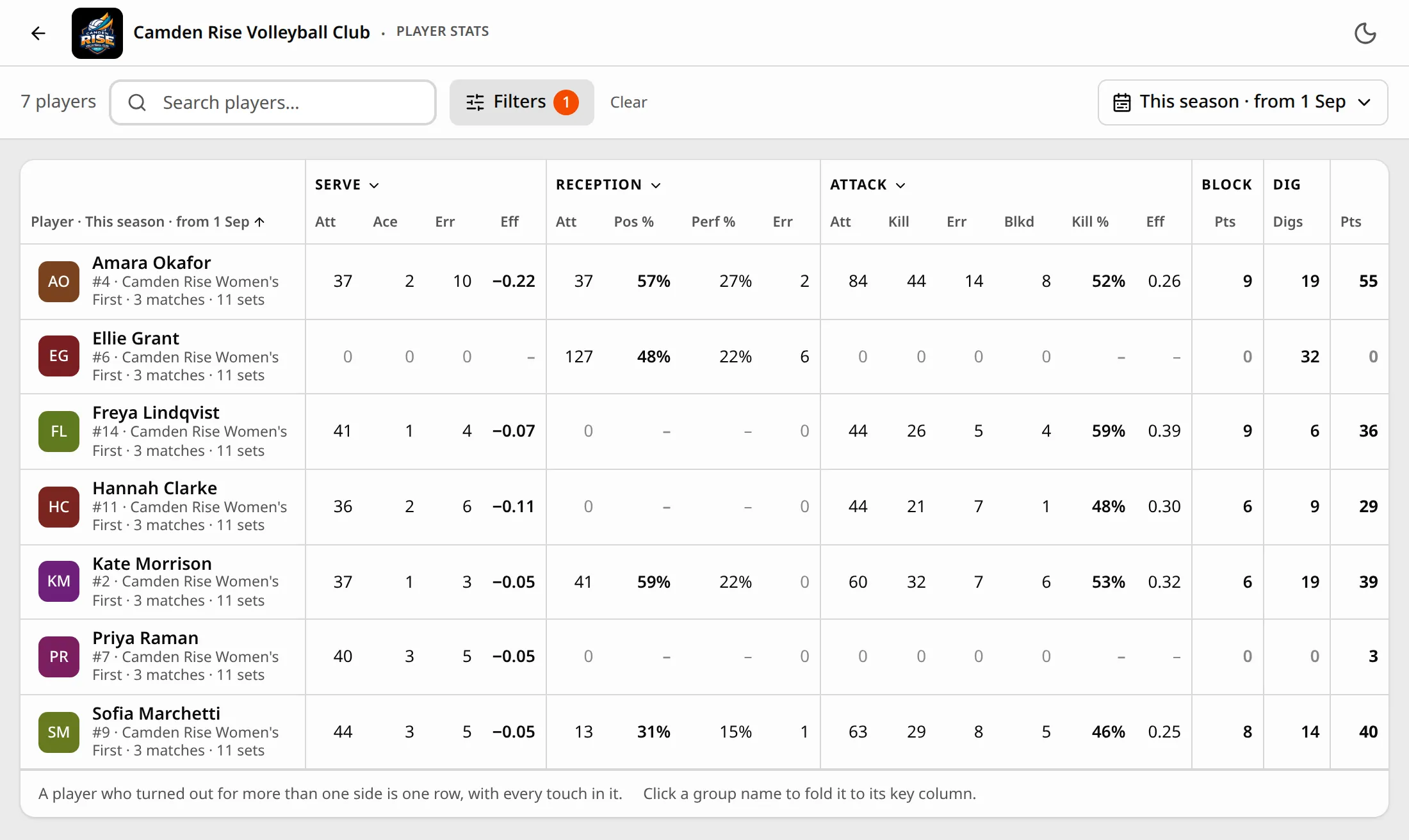
A player-stats grid for the whole club, filtered by team, group, match and dates, with the season running from 1 September. A player's totals can appear on their profile too, but only if they switch that on, and a guardian holds the switch until they are 18.
Scrimmage days count
A training-night scrimmage is a match like any other. Put one squad on both sides and each half gets its own bench, or fill a side with guests, who arrive with the next free shirt number and nothing else to fill in. Play open sets — sets to 25, as many as you play — and finish when you finish. Stats kept on a scrimmage count towards a player’s season the same as a fixture’s do, and so do tournament matches, which are scored on the same console.
On the web, at the table
Scoring and stats are web tools: open the match in a browser on the laptop or the tablet at the scorer’s table. Every entry is saved on the device first and sent behind it, so the console keeps going when the hall’s Wi-Fi drops and catches up in the doorway, and if two devices end up scoring the same match it says so rather than guessing. The iOS and Android apps cover the club, its events, chat, payments, drills and session plans; they do not score or keep stats.
Who it’s for
Clubs that play fixtures
Score at the table on a laptop, keep the result on the match the club already has in its calendar, and stop typing scoresheets into a group chat.
Coaches who want numbers from real games
Evaluation measures drills. Touch stats measure what a player did under pressure, in the matches that count, and follow them across the season.
Tournament organisers
A tournament match is a match event, so the same console and the same stats run at every court on the day, and the result moves the bracket and the table.
Common questions
Does the scoring console follow the official volleyball rules?
Yes. It is written to the FIVB Official Volleyball Rules 2025–2028 and checks what a scorer otherwise carries in their head: six substitutions a set with the return rule, and exceptional ones outside them; where a libero may stand, and a completed rally between two replacements; what each sanction costs; a deciding set's own toss and change of ends; and how a rotation fault is put right. It does not referee. The referee's calls are what you record.
Can we score a match if the other team is not on Spike?
Yes. Name the other side by hand when you create the match. A side with no squad on Spike gives no line-up, so the console keeps the points without drawing its court, and a match between two such sides is scored as a plain scoreboard. Your own side still gets its line-up, its rotation and its stats.
Who can score a match, and who can keep stats?
Whoever runs the event scores it: the organiser, or club and team staff with event permissions. Anyone else on the event sees the same console without the controls. Stats belong to each side: its staff keep them, and can name statisticians who keep that side's stats on this match without running the team. An organiser who runs neither team reads the reports but not the logs.
What happens if the hall's Wi-Fi drops?
The console carries on. Every entry is saved on the device the moment it is tapped and sent to the server behind it; the header shows Offline and how many entries are waiting, and they go the moment the signal comes back. If two devices end up scoring the same match with points the other has not seen, the console says so and asks which log to keep rather than merging them wrongly.
Do we have to record every touch to get the stats?
No. Type or tap only the touches you want graded, or enter a rally as just its ending: the point still counts, and the rally is left out of the rates so it cannot skew a percentage. You can keep stats live from the bench or from a recording afterwards, and you can score a match on the Score tab with no stats at all.
Can I score on my phone?
The console is a web page built for a laptop or a tablet at the scorer's table, with a full-screen mode so the court fits the screen. Scoring, stats and the reports are web tools. The iOS and Android apps cover the club, its events, chat, payments, drills and session plans, and do not score or keep stats.
Where do the stats go afterwards?
Into the match report, a player card for everyone who touched the ball, a team's stats over any date range, and a player-stats grid for the whole club filtered by team, group and match. A player's season totals can appear on their profile too, but only if they switch that on, and a guardian holds the switch until they are 18. Match-by-match figures, errors and rotations stay with the club.
The rest of the club, too
Score the next one properly
Create the match, name the officials, and open the Score tab on the laptop at the table. There is nothing to pay and nothing to install beyond a browser.
Score your next match